Saturday, May 6, 2023

Cameron County Birdathon 2023

4/30/23 

After being jolted awake at midnight by an Emergency Alert by the NWS warning of a severe thunderstorm on its way with 80 mph wind gusts, I didn’t get that planned extra two hours of sleep, especially when said storm hit with a vengeance!  Except for a couple of short glitches, thankfully the power didn’t go out (my boss and other friends around the Valley didn’t fare so well on that account L), and headed out to Resaca de la Palma State Park at 5:00 to hopefully bag some night birds and sit in the dawn. 

Had to park outside the park as the first gate was still closed (and the wind still howling to boot), but as I got settled, interestingly the first bird I heard was a migrant Dickcissel flying overhead in the dark!  Because the wind was so bad I opted to sit in the car and listen, and it was awhile before things started tuning up; the first brave soul was a White-winged Dove (2), followed by a distant Cardinal (3).  A Common Nighthawk (4) “beented” low overhead, and a Brown-crested Flycatcher (5) and Couch’s Kingbird (6) competed with their dawn songs.  I was very gratified to hear a distant Chuck-will’s-widow (7) singing from the woods, but was surprised that he beat out the resident Pauraques, which were soon to follow (8).  Soon more things joined the Dawn Chorus:  the sad lilting of the Clay-colored Thrush (9), the familiar cooing of the Mourning Dove (10), a rollicking Carolina Wren (11), a tittering Tropical Kingbird (12), a bouncy Olive Sparrow (13), and a raucous Green Jay (14).  As it got lighter a few Black Vultures (15) left their roost, and was very happy to log the distinctive “dear-dear-dear” of the Beardless Tyrannulet (16), a mid-Valley specialty making inroads into Cameron County!  Soon the Kiskadees (17) woke up, and a Great-tailed Grackle (18) flew over.  Some chattering from the trees betrayed the presence of several Baltimore Orioles (19 – these guys would be all over the county this day), and a Long-billed Thrasher (20) started his halting song. A Golden-fronted Woodpecker (21) called from somewhere, and a pair of Brown-headed Cowbirds (22) sat on the wire.  When the sunrise alarm went off and I prepared to leave, a singing Bronzed Cowbird (23) got in just under the wire!

Heading back up New Carmen Road to the freeway, a Turkey Vulture (24) sailed across the road, and several Eastern Meadowlarks (25) sang from the mesquite savannah on the west side of the road.  A Red-winged Blackbird (26) sang on a wire along Olmito Road, while a Black-crested Titmouse (27) whistled from a tree somewhere.  A couple of Starlings (28) flew across the freeway heading south, along with a few Rock Pigeons (29), and once off the freeway an onto the urban roads was able to hear House Sparrows (30) and log a Mockingbird (31) flying up to a snag.  I pulled over to write down what I had seen/heard before I forgot them (easy to do the older I get L), and in the process logged a calling Rose-breasted Grosbeak (32) in someone’s yard!

Turning right on Southmost Road, then turning right on Sabal Palm Road, added a singing Blue Grosbeak (33) in the field.  However, I was dismayed upon cresting the levee to discover that Sabal Palm Sanctuary was closed! L  I assumed it was due to storm damage (normally Wednesday is the only day they’re closed), but still disappointed in that this is one of the few places in Cameron County to bag the specialty woodland birds that favor the riparian forest (at least those you didn’t get at the dawn watch at Resaca de la Palma)!  So I turned around and at least stopped along the road for a couple of minutes to bag what I could, and added fly-by Barn Swallows (34), a flyover Laughing Gull (35), and singing Black-and-white Warblers (36).  An Olive Sparrow popped up for a picture, while a Harris’ Hawk (37) soared overhead and an Eastern Wood Pewee (38) caught bugs and returned to his snag.  A Chimney Swift (39) batted over, and about then another birder rolled by, saw the closed gate, turned around, and asked me about it – turned out he was doing a cross-country birding trip and was terribly disappointed that the place was closed!  But he was headed to South Padre Island next, and I knew the show would be good there (as the trees along the road were filled with more orioles)!  On the way out I bagged a Lark Sparrow (40) in the field.

Olive Sparrow

Baltimore Orioles 

A pair of Black-bellied Whistling Ducks (41) flew over the road on the way to Old Port Isabel Road (herein OPIR), and about that time a report came over the LRGV Rare Bird What’s App group that the Sheepshead Lots on the Island were just hopping with migrants, including some hard-to-get warblers!  I was sorely tempted to drop the plan and run over there, but the Lord had to remind me that the point of a Birdathon is to hit the key habitats, come what may, and that it was best to stick with the plan.  So stick with the plan I did, and was rewarded at the first stop along OPIR (which can be a dicey dirt road but is necessary to bag certain coastal prairie species) with a singing Cassin’s Sparrow (42)!  Further down a Whimbrel (43) flew by, and the breeding Willets (44) were calling all over.  The only reason Cattle Egret was #45 was because I forgot to write it down once I got to OPIR (I had seen one in transit), but a Mottled Duck (46) and Snowy Egret (47) in the canal were technically the next birds seen.  Somewhere a Killdeer (48) called, and a pair of Caracaras (49) flopped around in the distance.  What was even more shocking was hearing the deep “double note” of a pair of King Rails (50) from a hidden wetland; normally an inland fresh-water bird, any reports in Cameron County get flagged, probably due to the similarity with the coastal Clapper Rail, and the reviewers want to make sure the person submitting the report really did have a King Rail!  In another little pond a Coot (51) and Northern Shoveler (52) got added, and finally logged a singing White-eyed Vireo (53) in the thornscrub.  Many swallows were going through:  mostly Barnies, but I was able to get on one long enough to nail down as a Bank Swallow (53).  A Verdin (55) chinked from the scrub, and at the pond past the “Creepy Chicken Coop” a Least Sandpiper (56) poked along.  A roadside bush had more Baltimore Orioles, but in addition, a Hooded Oriole (57) “wheeped” and then made a brief appearance! 

Not too far past that is where “county maintenance ends” where, unless absolutely dry, you don’t dare go any further (which is too bad, because the habitat down there can be good for Aplomado Falcon, which I dipped on), but a two minute stop at least added singing Bobwhites (58)!  I kept seeing these little birds zipping through and buzzing, and finally got a good enough look to safely count Indigo Bunting (59 – which I wasn’t really worried about as I knew there’d be droves of them on the Island), and a pale-rumped, dark-headed swallow proved to be a Cliff (60).  A cute Lark Sparrow posed for pictures by the road, and another little pond on the way out thankfully had a Least Grebe (61, as I usually get that one at Sabal Palm).  Past the railroad tracks in a flooded field a Lesser Yellowlegs (62) fed close to the road, and a whole flock of Franklin’s Gulls (63) lazed further out!  Huge Loma Alta Lake is always right in the sun, so I usually don’t give that much of a look, but this time it was easy to pick out a Roseate Spoonbill (64)!


The infamous Old Port Isabel Road... 

Franklin's Gulls

Lesser Yellowlegs

Lark Sparrow

So because OPIR was impassable (I really didn’t expect otherwise after the storm) I backtracked and headed up SR 48 to Port Isabel.  On the way I stopped at the boat ramp for shorebirds, as I figured The Flats behind the Convention Centre would probably be inaccessible as well, and it turned out to be very productive.  Along the highway picked up a Chihuahuan Raven (65) being chased by something (probably a Mockingbird), and at the boat ramp itself added squeaky Least Terns (66), Black Skimmers hunkered down in the vegetation (67), a Semipalmated Plover (68), and a single Neotropic Cormorant (69) in with the group.  A Royal Tern (70) flew over, and both a Sanderling (71) and Ruddy Turnstone (72) fed close to the parking lot.  A couple of Black-bellied Plovers (73) flew by, and heard the harsh calls of a Sandwich Tern (74).  Lastly, several Black-necked Stilts (75) were against the bank.

Headed up to the Island after that, adding a Brown Pelican (76) hanging in mid-air as I went over the causeway.  As expected, the parking lots closest to the Convention Centre were packed with the cars of birders looking to take advantage of the “fallout”, but I drove to the back of the building first to see if I could access The Flats via a little trail there (you can actually drive out there, but after being chastised by my mechanic for rusting out my car’s undercarriage, I try not to do that anymore), but the water was right up to the shore, so considering the probability that I wouldn’t be able to park any closer to the garden area, I just walked over from there.

During migration faithful volunteers will put out seed, oranges, and nectar for the tired birds, and the Ruby-throated Hummingbirds (77) sure appreciated that!  The wind was still howling, so it was tough to see migrants in the trees, but circling around the “back yard” managed to add Catbird (78), American Redstart (79), and Northern Waterthrush (80) to the list (Baltimore Orioles were still monopolizing the joint).  Ran into a couple of beginning birders who were puzzling over a bird they had seen, and were doubly alarmed as the only match in the book they could find was an Evening Grosbeak, which would be unheard of here!  I was puzzling myself, when I found a Dickcissel right where they said the bird had flown, so I got them on it, and that’s indeed what they had seen! 


Gray Catbird

Female American Redstart

Northern Waterthrush

Heading out on the boardwalk a flock of Eastern Kingbirds (81) posed, and managed to add Great Blue Heron (82) and an immature Little Blue Heron (83) in the tidal area.  While others managed to get some good migrants in the mangroves, I couldn’t find a thing (not even the Pied-billed Grebes that are usually out in the bay), so I headed back and ran into Michael and Donna Marsden; Michael was a birding buddy who would often do some guiding for my boss Keith!  They had mentioned a Scarlet Tanager (which I had missed), but it showed again at the foot of the boardwalk so I could count it (84)!  A nice male Common Yellowthroat (85) popped up, while Michael had also reported seeing a Least Flycatcher and another puzzling Empid; thankfully the Puzzle came in, which turned out to be an Acadian Flycatcher (86)!  (Dipped on the Least, though… L). 


Acadian Flycatcher

Common Yellowthroat

Eastern Kingbird

I returned to the other boardwalk through the freshwater marsh and added Tricolored Heron (87), and at the blind at the end where I rested for five, logged a Common Gallinule (88), Green Heron (89), and a flyover Marbled Godwit (90)!  This particular boardwalk passes a pond where, on the way back, I spooked a pair of Blue-winged Teal (91), but also some shorebirds close by that I hadn’t noticed on the first pass, and wouldn’t have noticed this time if the Pectoral Sandpiper (92) hadn’t yelled at the Western Sandpiper (93)!  But in the mix was a larger sandpiper that I puzzled over, finally settling on Baird’s (94), because it can very similar to the White-rumped Sandpiper in some plumages.  I ran into Michael and Donna again at the foot of the boardwalk and told him about the sandpiper, and he was very anxious to go check it out (not Donna – she was there for the warblers J)!  He concurred that it was a Baird’s due to the all-dark bill (White-rumped has a chestnut base to the lower mandible which is diagnostic – if you can see it)!  He also picked out a Stilt Sandpiper (95) that I had missed, and an overhead swallow that turned out to be a Rough-winged (96). 

Baird's Sandpiper (middle) with smaller Western Sandpipers

Pectoral Sandpiper (right) bullying a Western

Back at the gardens, warblers were showing up at the water feature and thereabouts:  was able to add Magnolia (97), Chestnut-sided (98), and an Ovenbird (99) almost at my feet that I couldn’t spot (my eyes are really getting bad L)!  Donna had seen a Golden-winged Warbler (one of those hard-to-find migrants) while Michael and I were grueling over shorebirds, and I so wanted that to be Bird #100!  So we waited patiently for it to show up (Donna spotted a Lincoln’s Sparrow, a common wintering bird, in the meantime and I refused to look at it J), but a Summer Tanager at the water feature ended up taking that honor!  A Veery (101) also popped up in there, and when I finally declared for the umpteenth time that I had to get moving (every new report of the Goldenwing sent me back J) I was able to add a Yellow Warbler (102) and a female Painted Bunting (103) on the way to the car. 

Transitioning (from immature to adult plumage) male Summer Tanager

Chestnut-sided Warbler

Ovenbird

Even though the next-door Birding and Nature Center boasts the same habitat at the Convention Centre (indeed, in the old days they shared boardwalks), good migrants can still show up there, so I swung in and spent five minutes at their “parking lot” water feature, where more Baltimores and Rose-breasted Grosbeaks showed up (in addition to another waterthrush), but nothing new for the list. While sitting at the Songbird Alley water feature a pair of Clapper Rails (104) sounded off from the salt marsh, and a young Orchard Oriole (105) came in to the drip.  I took a quick walk around their one-mile boardwalk loop and only added Short-billed Dowitcher in the shorebird department (106), and at the very end some flocking Purple Martins (107); the wind was just keeping everything down, including the vagrant Hammond’s Flycatcher I was hoping to bag!

Next was the Valley Land Fund Lots on Sheepshead, where I was hoping the action would still be as good as it had been that morning, but alas, a lot of the goodies had moved on (including yet another Goldenwing, and a Cerulean Warbler that was so tired it was giving everyone there great photo ops).  Again, faithful volunteers were putting out multiple oranges, and most of these were being claimed by Tennessee Warblers (108) in addition to the ubiquitous orioles.  I ran into Michael and Donna again, who pointed out a White-crowned Sparrow (109), a wintering bird I had to document as they should have left a while ago!  A Eurasian Collared Dove (110) made the list, as did an Inca Dove (111) that Donna found for me (I think she was amused by my getting excited about that, but for a Birdathon, every species counts)!  They had just seen the reported Lazuli Bunting, so we staked out that corner of the observation area to no avail, then watched the berm where dozens of Indigo Buntings and a few Dickcissels were feeding, hoping he might go there!  We got a Swainson’s Thrush (112) instead, and an Orange-crowned Warbler (113) came to a close orange.  Michael had told me about a Hooded Warbler back where I had parked, so I went back there, hoping to add it, but could only kick up a nonetheless very cooperative Redstart!  Another birder there said, “Did you find your Hooded Warbler?”  No.  “There it is right there!”  Great bird, with chuckles all around (114)! 

Male American Redstart

After checking out the whole area and not finding anything new, decided to head across the causeway and over to the Laguna Vista Nature Trail, another good migrant trap.  After parking and entering the trail, hit pay dirt with a Black-throated Green Warbler (115) in the little grove of trees there (which can often be the birdiest spot in the place, despite the three blinds with water features)!  Heading to the first blind I ran into Michael and Donna again, who reported a Blackburnian Warbler back at the entrance, so I went running back to spend about five minutes looking.  No Blackburnian, so I shuffled back to Blind #1, where a gentleman had just finished putting out some food and had reported a Kentucky Warbler and Yellow-breasted Chat!  So I spent a little over five minutes there (I normally spend 15 but on a Birdathon you gotta keep moving) and was able to pick up a Buff-bellied Hummingbird (116) at the feeder!  Nothing came in to Blind #2, but on the way to #3 a Common Ground Dove (117) flew out of the thornscrub and landed briefly on the trail!  In the blind, the White-tipped Doves (118) were doing their coke-bottle coos, and one even flew overhead in a display flight!  Was happy to pick up a Ladder-backed Woodpecker (119) calling, and mused about how all my additions were not migrants, but local birds that I otherwise would have probably picked up at Sabal Palm had they been open! 

But things livened up back at that little grove:  migrants were in and out, with yet another waterthrush in a puddle and Magnolia Warbler in the trees, but was thrilled to log a Yellow-throated Vireo (120) that gave great looks!  A Nashville Warbler (121) peeked at me, and from another tree a lovely Northern Parula (122) made a pass!  But even more exciting for me was a Philadelphia Vireo (123), not much to look at but a challenge to ID sometimes, and even easy to miss some years!  Back at the car, I was chatting with Lizzie, another birding buddy, when I noticed a note on my car:  it was from Donna, saying that the Blackburnian had come back!  Well, I did spend another five minutes staring down the tree she had him in to no avail, so I sadly let that one go… 

Backlit Magnolia Warbler

There were reports that Port Isabel Reservoir had some good shorebirds, but when I got there the trail I normally go on was impassable, and another entrance down the [dicey] road yielded nothing new (besides being blown off your feet and looking right in the sun), so I wrote that one off and took the back roads to the freeway, picking up White-tailed Hawk (124) on the way.  The next destination was Hanka Sod Farms on Weaver Road, as some migrant shorebirds favor that habitat.  But I first made a quick stop at the Ebony Unit of Longoria WMA where the resaca there yielded a Spotted Sandpiper (125) and several lovely Wilson’s Phalaropes (126), in addition to previously-logged ducks and coots.  Back at the car a Lesser Goldfinch (127) “wheed”, and driving slowly through the NWR tract on the way to Weaver Road bagged a calling Great Crested Flycatcher (128).  Sadly, there were no shorebirds at all on the sod fields (except for Killdeers), but did have several Lark Sparrows feeding close to the road!  Said road past the admin building was too slick to drive on (lots more sod fields are down that road), so I backtracked and headed up to FM 800 where hopefully the La Feria Sod Farms (also owned by Hanka Sod, I noticed) would have something.  Thankfully they did, and thankfully they showed up at a spot where I could safely get off the road:  three American Golden Plovers (129), a shorebird that only comes through in spring, so I was very happy to bag them! 


Wilson's Phalaropes

Lark Sparrow

American Golden Plover

Last stop of the day was Tiocano Lake, another NWR tract on a narrow road heading to Santa Rosa.  There are very few spots to safely pull over (and despite the 30 mph speed limit, locals fly down that road like nobody’s business), but right away I was treated to a mob of feeding shorebirds, most of which were Wilson’s Phalaropes and Stilt Sandpipers!  Fulvous Whistling Ducks (130) were calling unseen (until a little later), and added Long-billed Dowitcher (131) and Semipalmated Sandpiper (132) to the day list.  Crawling down to the intersection added a Loggerhead Shrike (133) on a wire before turning around, and then headed down to the one place you can get totally off the road, near a little fresh water opening where I parked and waited for sunset.  This is always productive, as just sitting and listening added Sora (134) and yet another King Rail (this is actually the most reliable place in the Valley to get that bird)!  Some White-faced Ibis (135) flew past, and as I got on a flock of egrets, I noticed a couple of young White Ibis (136) in with them!  A Yellow-crowned Night Heron (137) called from the opposite shore, and to the east I could make out the sharp “kleeping” of some American Avocets (138) along with the barking of the stilts.  The last bird of the day was a surprise flock of Yellow-headed Blackbirds (139)! 

Shorebirds at Tiocano Lake

At least I thought that was the final total:  I submit checklists to eBird for each place I visit, and while I might forget to write something on the running list, I rarely forget to enter things in the checklists as the pre-determined checklist itself reminds me of what I saw/heard.  Well, it turns out that I forgot to write down four birds, all along OPIR:  some Gull-billed Terns (140) feeding in the field with the Franklin’s Gulls, a Scissor-tailed Flycatcher (141) on a wire, a Great Egret (142 – actually had several that day), and an Upland Sandpiper (143) that took off and called shortly after starting on the road!  Despite some serious misses, the Lord certainly blessed!

Gull-billed Terns along Old Port Isabel Road


Monday, April 24, 2023

Hidalgo County Birdathon - 2023

4/22/23 – Hidalgo County Birdathon

The neighborhood Killdeer was sounding off as I was packing the car, so he got the honor of being the first bird, followed closely by the neighborhood Mockingbird (2), who got #1 last year!  Headed out to Estero Llano Grande State Park and arrived around 5:30, where Purple Martins (3) were gurgling in the dark, and several Pauraques (4 – the Valley’s answer to the north’s Whippoorwill) whistled all around.  The White-winged Doves (5) were starting their syncopated songs already (sunrise was around 7:07) as I headed to the back side of the Tropical Zone, and was thrilled to hear a “McCall’s” Screech Owl trilling as I made a detour to the restrooms to check for moths that had been attracted to the lights! 


Oslar's Leopard Moth

Confused Euscara

Bitten Ethmia

Settled in at the picnic table at the feeder area near Pauraque Hall, where White-tipped Doves (7) were moaning in the woods, and a Black-necked Stilt (8) barked from one of the ponds.  Soon a Mourning Dove (9) added his coo, and a Great Blue Heron (10) croaked, also from one of the ponds.  Shortly a Cardinal (11) started his cheerful song, and I was thrilled to hear a distant Chuck-will’s-widow (12 – another Whippoorwill relative), as the main point of getting there an hour before dawn is to pick up the night birds!  Also added Brown-crested Flycatcher (13), Black-bellied Whistling Duck (14) flying overhead, and Couch’s Kingbirds (15) starting their dawn songs.

The Chuck sounded like it was back around the Tyrannulet Trail, so I wandered to a picnic table back there to see in the dawn (and hopefully pick up the resident Great Horned Owl, which didn’t happen… L)  A Clay-colored Thrush (16) added his lovely song, and between then and sunrise I added (by ear) Yellow-crowned Night heron (17), Kiskadee (18), Carolina Wren (19), Olive Sparrow (20), Black-crested Titmouse (21), Great-tailed Grackle (22), Golden-fronted Woodpecker (23), Green Jay (24), and Red-winged Blackbird (25).  By then it was light enough to see, and when I got up to investigate some possible warbler action behind me, I discovered a big ol’ Turkey Vulture (26) on a dead palm!  A House Wren (27) burbled just as I left.


Turkey Vulture

Couch's Kingbirds

Continuing on the Tyrannulet Trail, this was one area where so many warblers were being seen previously, so I just poked along and listened for "seeps” and looked for movement in the trees, adding Inca Doves (28), Ladder-backed Woodpecker (29), and Long-billed Thrasher (30), all heard-only.  Finally got some migrant action when a female Rose-breasted Grosbeak (31) squeaked and showed herself on top of a tree!  A Brown-headed Cowbird (32) did his gurgling song, and a Hooded Oriole (33) wheeped.  Down in the park host area, the Chachalacas (34) were spreading the morning news with their chorusing back and forth, and a Mottled Duck (35) quacked from unseen Ibis Pond.  A Dickcissel (36) flew overhead, giving its diagnostic flatulent-like call, and some orioles chattered that I suspected were Baltimores but couldn’t rule out Orchard, so I chased them down until I glimpsed enough orange to satisfy me (37)!  An Altamira Oriole (38) gave his happy whistle in the distance for good measure.


Rose-breasted Grosbeak

I decided to sit at the Green Jay Drip for a while, seeing as it often can be a migrant magnet; a Buff-bellied Hummingbird (39) chattered behind me, and some Tropical Kingbirds (40) tittered from (I’m assuming) the parking lot, but nothing came in to the drip… L  I heard some seeping down the trail, so set off in search of the sources, but alas, the only bird I was able to get on was a Nashville Warbler (41).

Was time to hit the main part of the park with its wetlands, so headed over to the Visitor’s Center to check in and then check out Ibis Pond.  Birding buddies Huck Hutchins and Ranger Raul Garza were already there, getting ready to lead a bird walk; Huck had his scope on a Semipalmated Sandpiper (42) along with gobs of Stilt Sandpipers (43).  A White-rumped Sandpiper had been reported earlier in the week, and Huck had the suspect bird now, but he had his reservations about that initial ID and suspected the similar Baird’s Sandpiper – the bird did indeed turn out to be a Baird’s (44), similar in size and shape to the Whiterump, but more likely this time of year.  Also in the pond were a few Shovelers (45), Least Sandpipers (46), tons of Long-billed Dowitchers (47), and one lovely Avocet (48).  I moved to the boardwalk where the sun was in a better position, enjoying the Purple Martins gathering nesting material from the grasses along a side trail (as there’s a martin house right there on the main trail)!  Added a calling Yellowthroat (49) to the list, along with a Greater Yellowlegs (50) while this was going on.  There was a group of visiting birders on the boardwalk as well, and one of the guys spotted (no pun intended) a Spotted Sandpiper (51) fleeing to the opposite end of the pond!  Several pretty Wilson’s Phalaropes (52) swam around, and some Lesser Yellowlegs (53) flew in and joined the party.  One of the ladies pointed out a goofy-looking Yellow-crowned Night Heron on top of a tree in perfect light, while a whole flock of Avocets wheeled in and joined the lone individual that had been there.


Avocets (with one Black-necked Stilt in the back)

Stilt Sandpipers

Long-billed Dowitchers, Stilts Sandpipers, and one Avocet

Yellow-crowned Night Heron

Purple Martin house

Female martin gathering nesting material

Continuing on the boardwalk, I checked out Avocet Pond (which can be challenging as you’re looking into the sun on that one), but managed to add Snowy Egret (54) and Blue-winged Teal (55) to the list.  As I followed the trail over to Curlew Pond I heard a Pied-billed Grebe (56) singing, and Rough-winged Swallows (57) buzzing overhead.  Curlew Pond had a few Coots (58) that moved to the opposite side when I showed up, but the Tricolored Heron (59) stayed put.  A Common Ground Dove (60) sang from the brush as I added a pair of Gadwall (61) and a Common Gallinule (62) to the list.  They have a picnic table there which is a great resting spot, so I sat for five, adding a calling Sora (63) and a flock of Fulvous Whistling Ducks (64) that flew past. 

Tricolored Heron

From there the boardwalk crosses Dowitcher Pond, which at that point is mostly reeds, but opens up as you head towards the bridge to Alligator Lake.  Least Grebes (65) were calling unseen, much to the chagrin of that same group who desperately wanted to see them!  Chimney Swifts (66) chittered overhead, and a Great Egret (67) and more night herons occupied Grebe Marsh, but no namesake grebes for the visiting group.  Alligator Lake was pretty sparse bird-wise:  a Green Heron (68) called from the vegetation, but there was no sign of the hoped for Green Kingfisher, Least Bittern, Black-crowned Night Heron, or even cormorants.  I took a quick peek for Pauraques in their normal hangout by the trail, but I figured they were nesting now and therefore way back in the “stuff”.  The overlook was even more devoid of birds, but I rested for five anyway, and was rewarded with an Anhinga (69) croaking unseen in the sticks!

Subadult Yellow-crowned Night Heron

Ran into the group heading out, and they had miraculously found a Pauraque!  Even though I had gotten plenty of them singing that morning for the sake of the Birdathon, I snapped a quick picture for the blog (once I found the bird J) and headed back to the VC.  A Catbird (70) popped up along the canal, and back at the martin house the House Sparrows (71) had awakened and were chirping (and contrary to many claims, these martins and sparrows have been coexisting peacefully for years)!  Another quick look at Avocet Pond from the deck was very productive, as a couple of Roseate Spoonbills (72) and a White Ibis (73) had joined the crowd, and in Ibis Pond an appropriate White-faced Ibis (74) was feeding!  

Pauraque

On the way back to the car a Scissor-tailed Flycatcher (75) was on the wire, but while entering the eBird checklist I was really bothered by a single descending, emphatic note I had heard along the Green Jay Trail, thinking it sounded like a Veery to me, but knowing that they’re more expected towards the coast I wanted to get a second “listen” just to be sure, but the bird didn’t call again.  Even so, I saw that eBird’s checklist showed that they were expected at Estero, so I reviewed the recording on the Sibley Birds app, and there was no doubt in my mind after that that I had heard a Veery (76).

A visit to a sod farm is a must during spring migration, as that’s where you’ll get your “grasspipers” (hopefully, because they can be hit or miss depending on how much water there is in the fields).  Traditionally the Progresso Sod Farms was the hotspot of choice, but that property is now a housing development, so the only other sod farm in Hidalgo County that was within easy access was the Rio Rico Sod Farms down on US 281.  So I ran down there to check them out, but they were pretty devoid of birds (except for grackles).  On the way out I was able to log a singing Eastern Meadowlark (77), and lo and behold a sharp, rough call revealed a couple of Pectoral Sandpipers (78) having words!  So at least we got them! 

Pectoral Sandpiper

Since the migrants weren’t cooperating at Estero, I wondered whether a stop at Frontera Audubon Thicket (a famous migrant trap in the heart of Weslaco) would be worthwhile, but decided to go for it, as “you never know”.  Picked up Rock Pigeons (79) at the FM 1019/US 281 intersection, and a Cattle Egret (80) heading up FM 88.  Chris (the manager) was displaying an eBird list of migrants that Tiffany Kersten, a local guide, had gotten the day before (we had had a big bangy thunderstorm move through yesterday, so I was hoping that would result in grounded migrants today – not), so I went in hopefully, but as it turned out the only new migrant I bagged was a Northern Waterthrush (81) near the pond (picked up another Nashville somewhere along the trail).  The normal woodland Valley birds that I had logged at Estero were also there, along with a Green Heron at the pond and White-tipped Doves and Chachalacas at the feeders.  Along the back side that abuts an RV resort, a Painted Bunting (82) was singing (I don’t really consider them “migrants” as they breed here), and a Barn Swallow (83) chattered overhead.  Got distracted by a tiny moth on the Guinea Grass that turned out to be a Cabbage Webworm – no friend to the local farmers, probably! 

Chachalaca

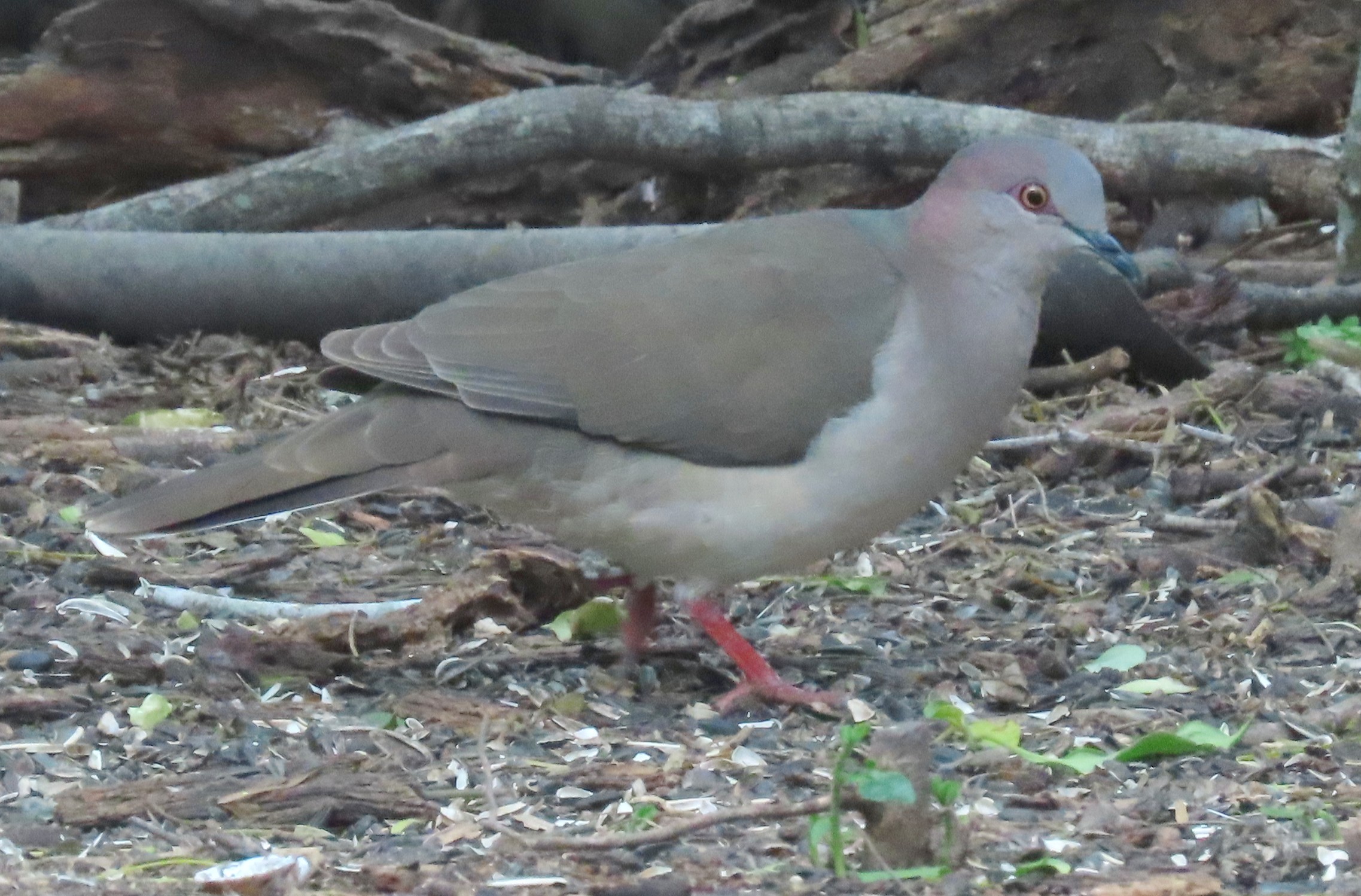
White-tipped Dove

Cabbage Webworm Moth

Green Heron

Now it was time to head up to the La Sal del Rey area, with a stop at the “1015 Pond” on the way.  This is a nice little roadside wetland that’s technically “behind” Delta Lake to the west, and while it can be feast or famine, it’s usually good for one or two additional species.  Today it provided a couple of Double-crested Cormorants (84) hanging with a Snowy Egret, and a flyover Laughing Gull (85).

There are several Lower Rio Grande Valley NWR tracts up in the ranchlands of the north part of the county, and this is where you really pack the list with “western” type open-country birds.  (The La Sal del Rey is just one tract, but I use that name for the whole route of dirt roads that I follow up there…)  But to get to the main route you have to “cheat” and pass through a little of Willacy County, so while traveling up Rio Beef Road (Willacy) I try not to stop for anything until I get to Ken Baker Road (Hidalgo)!  But if something just insists on being counted, I cave and add it to the list, like the pair of Swainson’s Hawks (86) that passed in front of me!  (I also added the Bewick’s Wren – 87 – that I heard on the fly, but I knew we’d hear lots of those along the route…)  This is a road-birding route, so the strategy is to stop every mile and listen for two minutes (kind of like a mini Breeding Bird Survey protocol); thus the first stop was there at the intersection of Rio Beef and Ken Baker, where tons of grackles and Bronzed Cowbirds (88) lined the wires!  (I think there were some Brown-headed Cowbirds in there, too…)  A little further down a pair of Lark Sparrows (89) were on the wires, and a chattering Pyrrhuloxia (90) got added on the fly.  At the next stop I was very happy to spot a soaring White-tailed Hawk (91), as this is the most reliable stretch for them!  And if I hadn’t bagged that Scissor-tailed Flycatcher at Estero, I knew I’d get them here, no problem! 

Bronzed Cowbirds (puffed up male on left)

At a cleared right-of-way I spotted a Roadrunner (92) and also heard him singing, so I couldn’t help but mess with ‘im:  by imitating his “coo”, you can get them to practically jump in the car!  This guy performed famously, running towards the car, wagging his tail, and cooing back at me with each “coo” I gave ‘im, until he finally just ran ahead of me and we “raced” down the road together for a bit until he finally dove into the brush (guess this competitor was too big for him J)!  A Curve-billed Thrasher (93) gave his rude whistle while this was going on… 

Roadrunner making his getaway...

Continuing on I was very pleased to hear a Black-throated Sparrow (94) singing, as they’re a desert bird that is by no means guaranteed along this route!  At the next stop I heard a Bobwhite (95) in the distance, and a pair of Caracaras (96) claimed a couple of power poles.  A Verdin (97) chirped in between stops, and once on northbound Brushline Road, a nice Harris’ Hawk (98) posed on another pole!  A stop at the corner where Brushline veers right, a Bullock’s Oriole (99) called and sat right up top of a mesquite, and a singing Cactus Wren got the honor of being Bird #100 (the oriole got it last year, so he came close J)!

There’s a large farm pond near the terminus of Brushline that always has something, and it was unusually full of birds this day:  a mob of Cattle Egrets in beautiful breeding plumage lined the south shore, along with a couple of spoonbills and an American Wigeon (101), as well as many shorebirds that were too far away to ID.  On the north side was a pair of Gull-billed Terns (102) making funny noises at each other, along with more ducks and a Greater Yellowlegs.  Backtracking down to SR 186, a Black Vulture (103) crossed the road, and heard more Pyrrhuloxias and even another Roadrunner, but nothing new until I crossed 186 and took South Brushline through the ag fields, where a Horned Lark (104) flew across the road.  I thought I heard a Groove-billed Ani (105) as I passed a row of thornscrub, so I backed up and listened for a minute; didn’t hear anything until a Cooper’s Hawk (106) came dashing in, and that got the anis going again!  On the way to the freeway a Common Nighthawk (107) flew high over the road! 

Cattle Egrets with token Spoonbill and American Wigeon

Was still missing some expected resident birds along with uncooperative migrants J, so decided to stop at Edinburg Scenic Wetlands on the way to the National Butterfly Center, as this can be a good place for both Ringed and Green Kingfishers.  Was really surprised that I hadn’t bagged a White-eyed Vireo yet, but one came through in the parking lot (108)!  Checked out the south pond first, where I finally bagged the Neotropic Cormorants (109 – if you don’t get one here, something’s wrong… J) hanging out with more Snowy Egrets.  A bona fide Mallard pair had been regularly reported (they’re actually rare in the Valley), but the pair I was looking at currently looked a little too dumpy for my taste (there are lots of “funny ducks” here that get into the mix), so I left them off the list.  However, a striking breeding-plumaged Forster’s Tern (110) was sitting on a post right off the overlook, and further out were several Ruddy Ducks (110).  

Forster's Tern

Back in the parking lot I ran into the same group of visiting birders who had unfortunately dipped on the kingfishers L, but I was still hoping!  This can be another great migrant trap; sadly the woods were quiet; but along the trail paralleling the north pond I heard a few seeps, and Glory Hallelujah a Northern Parula (112) popped into view!  There were lots of ducks, herons, cormorants, and even another Anhinga in the north pond, but nothing new, and as reported, no kingfishers there or along the canal… L On the way out a Texas Tortoise plodded along the trail, and a huge Texas Spiny Lizard posed nicely! 

Texas Spiny Lizard

Texas Tortoise

Next stop was the National Butterfly Center to try for the resident Audubon’s Oriole and reported Hook-billed Kite, but I wouldn’t have much time there before they closed, so I cowgirled up and took the freeway through that terrible construction at the I-2/I-69C interchange (I normally take great pains to avoid that) and made it through just fine!  Ran down to the feeder area to wait it out till closing time, and did indeed hear the sad note of the Audubon’s (113), but he never came in to the feeders (normally only upriver, this lost guy had paired up with an Altamira Oriole and produced some interesting-looking hybrid offspring).  What did come in included the normal White-tipped Doves, grackles and blackbirds, Green Jays and Cardinals, but I noticed a flash of color in the water feature, and Howdy Doody – a brilliant male Painted Bunting was taking a bath!  But even better for the Birdathon was a brilliant Blue Grosbeak (114) that came in above him!  I was also surprised that no Ruby-throated Hummers had shown up during the course of the day (because they should be coming through in droves now), so was relieved to see a female come in to the feeder (115)!  What also came in to the hummer feeder was a huge Altamira Oriole! J The ani on the wire was nice to see as well! 

Altamira Oriole

Female Ruby-throated Hummingbird

Blue Grosbeak

Painted Bunting

Groove-billed Ani

My warning beeper went off, so I headed out just as a staffer was coming to get me J, and headed over to Old Hidalgo Pumphouse to at least bag the Monk Parakeets.  Didn’t even make it to the Pumphouse before adding them (116) as they were rasping along Bridge Street!  Also picked up a chattering Western Kingbird (117) just before getting to the park proper, and I was really surprised at the number of people there; usually I’m there first thing in the morning and I have the whole place to myself!  Headed over to the overlook to hope for the kingfishers and Black Phoebe, but it wasn’t meant to be (had to disappoint another couple of guys with monster cameras who were hoping for the kingfishers as well).

 The last stop of the day was Santa Ana, and because the temperatures were so mild this year (as opposed to last year, when it was in the 100s by the time I got to La Sal del Rey), I could actually put in more time on Chachalaca Trail.  Going over the levee had several Bank Swallows (118) doing their rapid-fire calling overhead, and at the “multi-trailhead” area actually had a small migrant flock happen by!  Unfortunately the only birds I could get on were a Tennessee Warbler (119) and a Red-eyed Vireo (120) before they all took off, but I was thrilled!

 From there headed down the Chachalaca Trail to the Willow Lake Cutoff, where a Long-billed Thrasher was singing, but right on its heels was the distinctive dear-dear-dear of a Beardless Tyrannulet and wasn’t sure if it really was or if the thrasher was incorporating it!  Continued to a nice bench at a culvert with a great view of the wetlands, where there were gobs more water birds here, but the only new one was a Solitary Sandpiper (121).  Backtracking to Chachalaca and the view of Willow Lake there, found a couple of pairs of Cinnamon Teal (122) in with more ducks that had already been logged, including several American Wigeon.  A Glossy Ibis (along with a hybrid) had been reported several times amongst the big flocks of White-faced Ibis, so I checked those birds that let me see their face (they look identical except for the color of their bare parts – pink on White-faced and gray on Glossy), but they all looked to be White-faced, which is the default dark ibis here anyway (Glossy is the Florida/east coast sister species, and has been working its way along the Gulf coast to where now they occur regularly along the Upper Texas Coast and interbreed with the White-faced).  I was pondering that tyrannulet song all the way back to the parking lot and finally decided to include it (123), as while Mockingbirds are notorious for being excellent mimics (enough to fool even the most experienced ear-birder), thrashers rarely do, and that song was simply too clear and exact to be an imitation. 

White-faced Ibis still in non-breeding plumage

It was almost sunset by that time, so decided to head up to Alamo for the traditional dipped Dairy Queen cone J and to sit in front of the Alamo Inn’s Garden Suites waiting for the Lesser Nighthawks that nest on the roof to show up!  They did (124), along with a “beent”ing Common Nighthawk higher in the sky.  (Apparently some visiting birders had the same idea as they were having their own tailgate party with their eyes on the roof!)  Heading back home to the Alamo Country Club, I cruised around the complex until I heard a House Finch (125) and called it a wrap!  However, the cumulative eBird list claimed I had a total of 127 species, so comparing the two, I discovered I had forgotten to write down the Starling (126) and Collared Dove (127) I had bagged leaving Weslaco (but managed to input an on-the-fly eBird checklist…not surprising that I would forget about two introduced species!)


Cameron County Birdathon 2024

25 April 2024             I didn’t hold high hopes of getting a big list today, as not only were the prevailing winds from the south (theref...